Klondike Gold Rush National Historical Park
December 2025 - April 2026
Paper Conservation and Museum Intern
This role encompasses many areas of collections care and preservation through a variety of projects. I was part of a team processing, digitizing, and conserving a collection of late 19th century ship manifests. I was also part of a team processing and documenting objects from 2025 archeological digs. Finally, my team was in charge of regular environmental monitoring and IPM across the park's historic and new buildings.
Selected Work

Manifest Project
Along with two co-interns, I was a part of the fourth and final year of this project. We worked to continue the processing of a collection of late 19th century ship coasting manifests. This included paleography, digitization, and conservation.

Archeology Processing
Under the supervision of archeologists McClean Pink and Jonathon Flood, myself and two co-interns assisted with the processing and assessment of archeological materials from 2025 digs.

Outreach Project
Working with my two fellow interns, we met with a local group of kids ages 10-13 to help them curate an exhibit about local history. We helped them pick objects from the museum collection and prepared and led sessions teaching them about label writing and exhibit planning.

Preventive Conservation
My intern cohort was in charge of weekly checks of historic buildings, and monthly monitoring including collecting environmental and pest data.
Ship Manifest Project (ongoing)
Working with a team of two other interns, this project involved several aspects of archival processing. We worked to catalogue, digitize, and conserve a portion of a large colleciton of late 19th century and early 20th century ship archival documents, including coasting manifests, passenger manifests, waybills, and receipts.
We first catalogued each document, inputing central information into a spreadsheet including dates, watermarks, and names of companies and people. To do this, we had to decipher handwritten, and often faded, text.
Each document was then treated as necessary. This depended per item, but could include surface cleaning with soot sponges, local humidification (after solubility testing), and tear repair using wheat starch paste, methyl cellulose, and Japanese paper.
We then digitized the documents using a scanner or a digital camera, uploading the images, and properly filing them.
A central aspect of this project was the importance of team based work with my co-interns, pre-program conservation students Kelly Liu and Kate Arett. We collaborated extensively to assist with paleography, ensure consistent work, and share knowledge from our past experiences. Another part of this was working as a unique type of "team" with the three previous years of interns who worked on the project. We constantly were referencing their work and the materials they compiled to inform our ongoing work. This taught us a great deal about the importance of accurate records-keeping, thorough workflow documentation, and clean file management.

Application of Japanese paper during tear repair
Photo by Kate Arett

Sample document after tear repair using japanese paper and wheat paste (recto)

Sample document after tear repair using japanese paper and wheat paste (verso)
Archeology Processing (ongoing)
Instructed by archeologists Jonathon Flood and McClean Pink, I and co-interns Kelly Liu and Kate Arett assisted with processing of materials found during archeological digs in the summer of 2025.
The central goal of the project was to create a record of the amounts and types of materials found. This information was necessary for the archeological team to understand the site and make plans for next steps. It was also important to process items quickly in order to report any relevant findings to local tribes for review according to NAGPRA.
To assist with these goals, we did cursory cleanings of objects, described them, photographed them, and then re-boxed items. Once all the objects have been processed, the curatorial and archeological teams will decide what is relevant to the collection and will be accessioned.

Co-intern Kate Arett working to identify objects
Outreach
While working at the park, an after-school club of 5th-7th graders from the local school were interested in working on a collaborative project to learn about local history. The end goal of this project was to help the kids create an exhibit that they could speak about at a state competition for their club. The exhibit is also planned to be on view summer of 2026.
Collaborating with my co-interns, we planned and led five sessions with the club: an introduction to the museum space, selecting objects for the exhibit, two sessions writing labels and text, and a workshop about exhibit layout and design.
My favorite moment of this project was during our final session, guiding the students through the beginnings of exhibit design. Without us prompting, the students began considering and asking about the safety of the objects: if they would be safe from the weather, if the objects would fall over or get knocked off pedestals, and if it would be too cold or hot for the objects - preventive conservation! My entire team was amazed they had thought of these concerns, and we excitedly shared with them the importance of these considerations in museum spaces.

Photo by Elle McManus
From left to right: Kelly Liu, Kate Arett, and Briar Bell listening to students ideas about the exhibit theme

Kate Arett, Kelly Liu (not pictured), and Briar Bell leading session on writing labels
Photo by Elle McManus
Preventive Conservation (ongoing)
Me and my fellow interns Kate Arett and Kelly Liu are tasked with completing monthly preventive monitoring. After training with curator Martin Hobmeier, we are now responsible for collecting the monthly data and entering it into ongoing records.
The historical park consists of many different historic structures which must be monitored along with collection storage areas. We collect monthly humidity, temperature, and light data to keep track of ongoing or recurring issues. With intense and sudden shifts in weather in south east Alaska, this monitoring provides important information. One of the central collection buildings has also recently received a new HVAC system, so keeping track of its function in this early stage is crucial.
We also collect monthly pest data: tracking traps, replacing traps when necessary, comparing data to past months and years, and monitoring areas with increased activity.
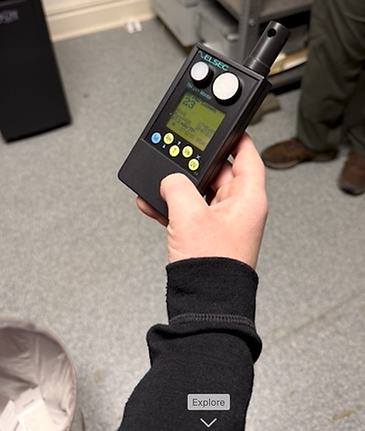
Taking Light Readings in KLGO storage space
Photo by Kelly Liu